
Posted on 5th May 2026
by Freya Parkinson

Paper has long been at the centre of the sustainability conversation, but not always for the right reasons.
From assumptions about deforestation to concerns around waste, there’s a growing perception that reducing paper use is the best way to protect the environment.
But the reality is more nuanced.
Understanding how paper is produced, used and recycled reveals a very different picture; one rooted in responsible management, circular thinking and long-term sustainability.
This blog aims to help debunk some of the most common misconceptions about the production paper.
The perception: It’s a common belief that modern paper use leads directly to forest loss, or that ancient forests are routinely cut down to meet demand.
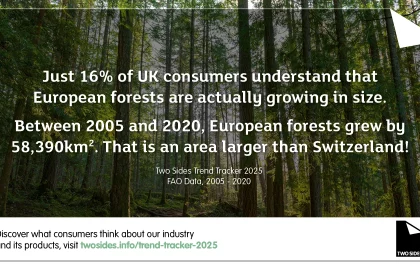
The reality: Across Europe, forests are not shrinking, in fact they’re expanding.
Data from Love Paper confirms that forests have increased significantly in recent years, with the equivalent of around 1,500 football pitches of new forest growth every day. (1)
Rather than depleting resources, the paper production system is contributing to the renewal of forests.
The perception: Another misconception is that paper production is a primary driver of deforestation.
The reality: Globally, deforestation is largely driven by land-use change such as agriculture, infrastructure and urban development; not paper production.
In Europe, paper sits within a managed ‘working forest’ cycle, where trees are grown, harvested and replanted in a continuous, renewable system.
The perception: There’s also a belief that once paper is used, it quickly becomes waste.
The reality: Paper is one of the most widely recycled materials in the world.
Europe leads globally, with around 75% of paper products (2) and 87% of paper-based packaging being recycled (3). Fibres are reused multiple times, supporting a circular economy and reducing the need for virgin materials.
The perception: It can seem logical that the best way to protect forests is simply to leave them alone.
The reality: Sustainable forest management plays a crucial role in maintaining healthy ecosystems.
Well-managed forests not only provide renewable raw materials, but also store carbon, support biodiversity and are more resilient to challenges such as climate change, pests and wildfires.
Paper, when responsibly sourced and properly recycled, is part of a renewable and circular system.
The challenge isn’t to eliminate paper use altogether, but to use it more thoughtfully.
By understanding the realities behind the material, businesses can make more informed choices. Enabling them to balance environmental responsibility with practical, effective communication.
In short, it’s time to move beyond the misconceptions and see paper for what it is: a resource that, when managed well, works in harmony with the environment rather than against it.
Sources: